Updated October 2026

Crowdfunding comparison 2026

Crowdinvesting (investment crowdfunding) platforms in Germany compared. Invest in real estate, start-ups, renewable energy and mid-sized companies (Mittelstand) – from €10.

Up to 9.5% return p.a.
Invest from €10
13 platforms

Return calculator

€
€100 €10,000
Term 24 months
12 months 84 months
%
1% Platforms: 4.5–9.5% 12%
Return at 7.3% p.a.
+€120
expected interest income
Total repayment
€1,120
at the end of the term
Example calculation with simple interest, excluding compound interest, taxes and default risk. The default setting is the median of the platform returns (7.3%) – the actual return depends on the individual project.
Filter:
13 platforms found
Return: 4.5% – 9.5% p.a.

Crowdinvesting platforms compared

Many hands supporting an idea Many hands supporting an idea

Types of crowdinvesting

Different asset classes for different levels of risk appetite

Real estate

Financing of construction projects, refurbishments or existing properties. Interest depends on project and risk, terms usually 1–3 years. In recent years, property developments have seen more delays and defaults.

Start-ups

Early-stage investments in young companies with high growth potential. Higher risk, higher potential rewards.

Higher risk

Renewable energy

Solar, wind and hydropower projects. Often long terms; returns depend on electricity prices, weather and project delivery, among other things.

Sustainable

SMEs / Mittelstand

Growth financing for established mid-sized companies. Often structured as a Nachrangdarlehen (subordinated loan).

Established

Advantages and risks at a glance

Advantages

What speaks for crowdinvesting
Higher interest: Higher than bank deposits – as compensation for the considerably higher risk
Low barriers to entry: Minimum amounts often between €10 and €500, depending on the platform
Diversification: Spread across different projects
Transparency: Detailed project information

Risks

What you should bear in mind
Risk of total loss: The capital invested can be lost
No deposit protection: No state protection
Illiquidity: Capital is often tied up for years
Subordination: Paid out only after other creditors in the event of insolvency

Crowdinvesting 2026: the comprehensive guide for investors

Crowdinvesting has become a popular form of investment in recent years. In this guide you will find out everything about crowdinvesting platforms, returns, risks and investment strategies – so that you can make well-founded investment decisions.
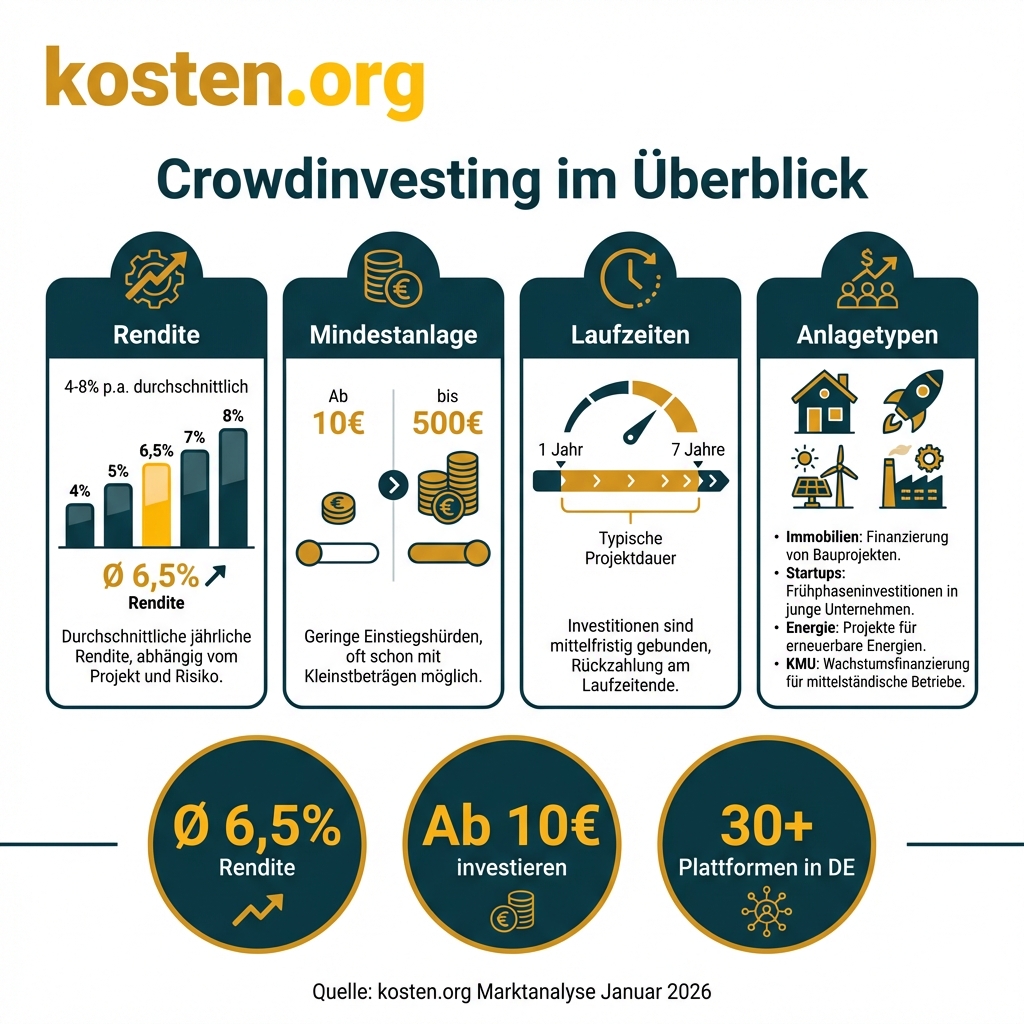
Infographic: crowdinvesting at a glance - return, minimum investment, terms and types of investment

Infographic: crowdinvesting at a glance (in German) | Source: kosten.org market analysis February 2026

What is crowdinvesting?

Crowdinvesting is a form of crowd financing (Schwarmfinanzierung) in which many investors jointly invest in projects or companies. In Germany this mostly takes the form of subordinated loans and bonds with fixed interest (lending-based), less often genuine equity stakes (equity-based crowdfunding). Unlike classic crowdfunding, investors here receive a financial return in the form of interest, profit participation or, if successful, company shares.

Good to know:

Many platforms now operate as crowdfunding service providers under the EU Crowdfunding Regulation (ECSP Regulation), authorised by BaFin (Germany's Federal Financial Supervisory Authority) or another EU supervisor – each project then comes with a key investment information sheet (Anlagebasisinformationsblatt). If a project is offered under the German Investment Products Act (Vermögensanlagengesetz) instead, no sales prospectus is needed for issues of up to €6 million, but a Vermögensanlagen-Informationsblatt (VIB, investment product information sheet) is mandatory. Retail investors may then generally invest no more than €1,000 per issuer – with a self-declaration up to €10,000 (with at least €100,000 in freely available assets) or up to twice their average monthly net income, capped at €25,000 (Section 2a VermAnlG).

How does crowdinvesting work?

  1. Choose a platform: Register with one or more crowdinvesting platforms
  2. Choose a project: Browse active projects by return, term and risk class
  3. Invest: Set the amount (often from €10-500) and complete the investment digitally
  4. Receive interest: Depending on the project, you receive interest payments quarterly or annually
  5. Repayment: At the end of the term your capital is repaid (provided the project was successful)

Tips for successful crowdinvesting

  • Diversify: Spread your capital across at least 10-20 different projects
  • Only invest spare capital: Do not invest money you will need in the short term
  • Check projects: Read the key investment information sheet or the Vermögensanlagen-Informationsblatt (VIB) carefully
  • Platform track record: Favour established platforms with a proven record of success
  • Tax treatment: Interest income is subject to Abgeltungsteuer (German flat-rate withholding tax, 25% + Soli, the solidarity surcharge, plus church tax where applicable); saver's allowance €1,000 per person

Tip for beginners:

Start with small amounts and spread them across several projects and platforms. Look at the collateral (e.g. a land charge or merely subordination), the developer's track record and how the platform handles delays and defaults. Projects with short terms and regular interest payments can also default – as real estate projects have repeatedly shown since interest rates rose in 2022.

As of: October 2026 | All information without guarantee. Crowdinvesting involves considerable risks. Links marked with an * are affiliate links: if an investment is made through them, we receive a commission – there is no extra cost to you. Projects with a partner programme are listed first; platforms without a partner programme are linked directly.

KB

Konstantin Botschmanowski

Finance expert ✓ Verified

Founder of kosten.org. As a former client adviser at an online broker and an active trader with more than 10 years of experience in the financial markets, I regularly rate brokerage accounts, brokers and financial products based on their published terms. My focus: transparent comparisons without hidden costs!

Updated: October 2026 Editorially reviewed 10+ years of financial market experience
Plant growing from a coin stack Plant growing from a coin stack

Frequently asked questions

How safe is crowdinvesting?

Crowdinvesting is not a safe investment. There is a risk of total loss, and no deposit protection applies. How many projects default depends heavily on the asset class, platform and market phase: a considerable share of start-ups fail, and real estate projects have also seen more delays and defaults since interest rates rose in 2022. Check the default and repayment statistics published by the platform.

What is the minimum amount I can invest?

It depends on the platform and project: some platforms allow amounts from €10, many require €100 to €500 (e.g. Companisto from €250). You will find the minimum investment per project in the overview above.

How is crowdinvesting income taxed?

Interest income is subject to Abgeltungsteuer (flat-rate withholding tax: 25% + solidarity surcharge, plus church tax where applicable); the saver's allowance of €1,000 (€2,000 for jointly assessed couples) applies. If the platform does not withhold tax, declare the income in the Anlage KAP tax form. Losses from defaults can be offset against other capital income – the former cap of €20,000 a year was abolished by the 2024 Annual Tax Act.

What happens if a project fails?

If a project defaults, you face a total loss of the capital invested. As crowdinvesting loans are usually subordinated, investors are only paid after other creditors in the event of insolvency.

Risk warning: Crowdinvesting investments involve considerable risks and can lead to the total loss of the capital invested. This form of investment is only suitable for investors who can bear a financial loss.

Transparency note: Links marked with an * are affiliate links. We receive a commission if you open an account via these links – there is no extra cost to you. This allows us to offer this comparison free of charge.